
Within the next 19 months, and potentially a lot sooner if all goes to plan, those in the UK with pensions not yet in payment will be able to use a free, government-backed website to view their estimated retirement income (ERI) from their state pension and any occupational and personal pensions they have built up in their working lives.
This will be a very big thing for UK pensions and the nation generally. As Richard Smith, a career pensions professional since 1987 and an expert adviser on the UK pensions dashboard initiative, puts it: “If you walked down your local high street and asked 100 people on a random basis: ‘Who are your pensions with?’, how many of them could answer that?”
“Most will say something like: ‘I used to work in the health service, so I know I’ve got an NHS pension, but I don’t know what else I’ve got’”. Smith cites research which found that only around one in five know the totality of their pensions[1], so out of the UK’s working age population of around 40 million people, over 30 million don’t know who their pensions are with or what total income they might get. “Personally, I feel embarrassed as a pensions professional that the UK pensions industry has let that happen,” says Smith.
Building the ‘Eiffel Tower’
To fix this problem, the pensions dashboard project, which was originally proposed in the 2016 Budget, is due to launch during the 2027-28 financial year. A key reason it has taken so long is the immense volume of work involved in putting in place the necessary legislation and regulations, creating data standards, building the digital systems and generally ensuring that the new technology ecosystem works as intended.
To illustrate the scale of the project, Smith compares the pensions dashboard ecosystem to the shape of the Eiffel Tower. “The layer at the very bottom is the whole pensions industry; all the pension schemes, providers, other pension arrangements and the state pension. The logos at the bottom right represent the legislation required to mandate that all the schemes and providers in this layer must make their data digitally searchable,” he says.
“When a consumer uses the dashboard, their data is sent up the tower via the integrated service provider (ISP) layer which enables pension schemes to connect their data to the ecosystem. Then layer four is the central digital architecture that orchestrates the search, where the government procured a Capgemini/Origo consortium to build those components.”
Chart one: How the UK pensions dashboard will work
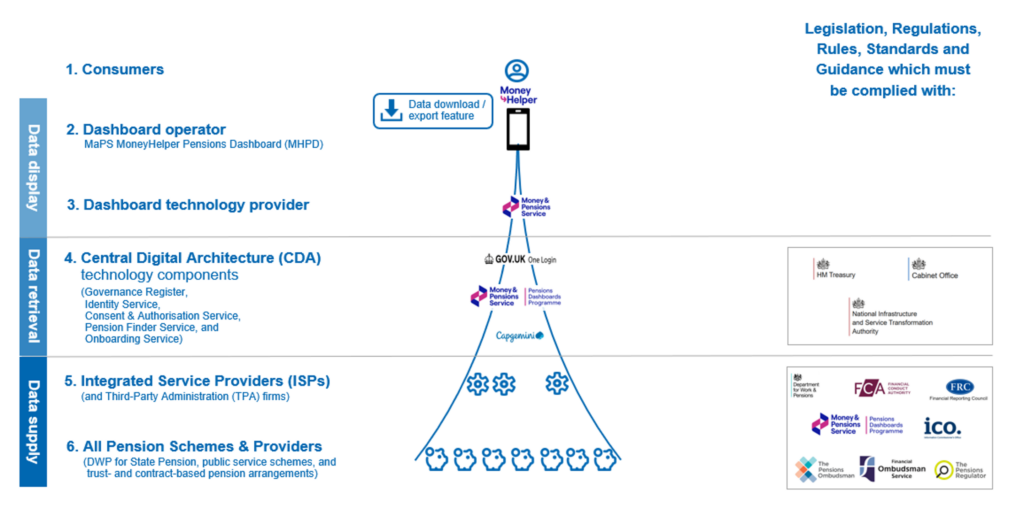
Moving upwards, the Money and Pensions Service (MaPS) has built the front-end experience, the MoneyHelper Pensions Dashboard (MHPD), which is now undergoing live private beta testing prior to full public availability.
Smith’s involvement and support for this project means that he is happy to share a screen shot of his own ERI from his various pensions, from the live testing stage. It shows the ERI from each of his eight pensions and the total estimated income. “You have to see this to get it. Each pension has an ERI showing what you could get by the time you reach pension age,” he says.
Chart two: An example of how users could see their estimated retirement income

Clicking on each pension tile leads to more information on that pension. But there are caveats, as Smith explains: “It’s an estimate and the dashboard wording says not to make decisions about money and pensions based solely on the dashboard, as the values are based on assumptions and are for illustration only. If you want more definitive figures, you should go into the details for each pension and then click through to that pension scheme administrator or provider to request a definitive quote.”
While Smith’s ERI from 2034 looks quite high, it should be said it is before income tax and it also assumes that no tax-free cash lump sum is taken, which would reduce it further. Using the Retirement Living Standards (RLS) as a benchmark, Smith’s post-tax income, which is more likely to be £3,500 a month (or £42,000 a year) is between the RLS Moderate and RLS Comfortable figures for a single person London household.
To view their own ERIs, individuals will need to use GOV.UK One Login, the UK government’s digital ID service. When they log in, a user’s verified personal details are passed to layer five and six in the Eiffel Tower. In 80 seconds, the system checks over 100 million pension records to see if there is a match and it comes back with this screen, showing all of their pensions.
Smith describes this as incredible: “I can’t think of any other data project that is so vast. It covers data going back decades and covers the whole of the working age population and even older people, if their pensions are not yet in payment. This is why it has taken so long; we did the data standards in 2020, the legislation came through in 2022, 2023 to 2025 saw the data connection build, while 2025 and 2026 has seen the testing of the front-end experience.”
Full coverage from day one
One big difference between the UK and the Nordic countries*, which launched their own dashboards decades ago, is that the UK is implementing mandatory coverage for all pension providers from the start. The Nordic countries did this on a voluntary basis and it took 10-15 years for all pension schemes and providers to join.
“The UK has a very diverse and complicated pensions industry for historic reasons, so it was unlikely that it would ever work on a voluntary basis here. The upside is that we will have full coverage on day one,” says Smith.
But the downside is that the UK will face data issues across the whole universe from day one. Layer six has to cover public sector unfunded defined benefit (DB) schemes, like the NHS scheme or the teachers’ pension and civil service pensions, as well as the local government DB scheme, which is funded. There is also private sector DB, which could be deferred or going to buy-out, plus standalone employer defined contribution (DC) funds, the master trust DC plans, group personal pensions, individual personal pensions and self-invested personal pensions.
“We had to come up with a data standard that would work for that whole universe for day one coverage,” Smith explains.
Smith has done a European tour to learn from countries like Sweden and Denmark. A key lesson was that it is only when the dashboard is launched that holes in the data coverage are really found at scale. “Based on their experiences, it could take five to eight years from full public availability before all the issues are exposed and it is properly bedded down. But they all said that you have to launch; if you aim for perfection, you will never launch. You have to incrementally expose data issues and then resolve them. It is a positive, virtuous circle of exposing the data to get it improved, which only happens when individuals see their data.”
In the Nordic countries, additional functionality has been added over time, for instance to enable users to model the impact of changing their retirement date. Additional features like this can also be offered by commercial providers too, such as banks or pension providers.
While private sector dashboards are possible in the UK, Smith does not see this happening in the near future. “A provider could create an AI tool to read your data on the MHPD, with your consent, and then help you plan your retirement. But the data from the MHPD will be quite shallow to start with. It is also out of date in that your DC pension income isn’t based on your DC fund value now, but from your last statement, which could be up to 12 months ago. That doesn’t really support active, detailed retirement planning. It is more of a broad brush approach, showing what income you might get ten, 20 or 30 years from retirement.”
Smith adds: “I chaired the Dashboard Operators Coalition of 15 firms that all wanted to do a private sector dashboard. We disbanded it in 2025 because the firms couldn’t make a commercial case for it. It’s a non-trivial spend to build, test and operate a private sector dashboard, but we may see them eventually. In Norway, the official dashboard launched in 2008, then in 2015, they opened it up through APIs to private sector apps. So we could have MHPD availability in 2027 and then maybe in the 2030s there will be private sector dashboards.”
For Smith, who has been involved in the dashboard in various capacities for the last 12 years, the UK pensions dashboard has become something of a holy grail. “The quest for the holy grail is about striving for a goal that is almost impossible, but one that people really need. Anders Lundström was chief executive of the Swedish dashboard for 18 years and he described building and launching it as a long, complicated and painful process, but when you look back at it, you can see that you have helped many, many people.”
“Personally, I don’t think that I could have been involved, in all the different capacities over the last few years, in an initiative that has more social worth for millions of UK citizens for decades to come, than this. We have an ageing society, many people don’t know if they will have enough to live on in retirement, and this is something that will start to turn that oil tanker around. It is really hard to do, but maybe the hardest things to do in life are the most important things.”
Further reading:
See Richard Smith’s website, DashboardIdeas.co.uk | Thinking about how best to keep track of all your UK pensions, for more information on the UK pensions dashboard and pensions adequacy.
*For CoreData’s two-part series on the lessons from the Nordic countries to the UK on pensions dashboards, see:
Lessons the UK can learn from the Nordics ahead of pensions dashboard rollout – CoreData Insights
[1] Pension confusion leaves millions unsure if they’re saving enough | PLSA, PLSA press release 5 July, 2018
Matt Craig is a senior consultant at CoreData Group, a global specialist financial services research and strategy consultancy. To find out more about our industry insights and research programmes, you can reach him at [email protected]